
The Missing Signal: Real-Time Customer Experience Intelligence for the Entire Network
1. Introduction: Are We Still Missing the Most Important Signal?
Mobile operators are experts at analyzing what has happened. They collect immense volumes of performance data—every millisecond of latency, every megabit of throughput, and every blip in signal strength is monitored and archived. But ask a deceptively simple question:
"How is the customer doing right now?"
The answer is rarely clear.
The reason why is well known. The most accurate reflection of network experience—real-time user plane traffic enriched with control plane context—has historically been too massive and complex to process and too expensive to store. Existing systems focus on infrastructure telemetry, sampled analytics, 3rd party reporting (e.g., DownDetector), or customer complaints. These methods leave a persistent blind spot around the actual, live experience of the user.
Opanga’s RAIN platform breaks this barrier. It delivers a network-wide Customer Experience Signal that is immediate and actionable. RAIN turns the network into a living, responsive system informed by the real-time activity and the customer experience of its users.
2. The Stakes: Why Real-Time CX Intelligence Changes the Game
In modern telecommunications, customer experience (CX) is a strategic differentiator. Winning requires understanding how the network performs at the only point that matters: in the hands of the customer.
Real-time CX intelligence isn’t just about fixing problems faster; it’s about unlocking new dimensions of strategic and operational performance:
Proactive Brand Loyalty: Identifying frustration before the customer does.
Precision Resource Management: Maximizing the ROI of every MHz of spectrum.
Operational Sustainability: Aligning energy consumption with actual human demand.
AI Readiness: Providing the high-fidelity telemetry required for autonomous operations.
3. The End of the Brute Force Era
Historically, mobile operators have approached customer experience through a single lens: Capacity. The industry operated under a simple mantra: If I build enough capacity, I reduce the chance of a negative customer experience.
This "brute force" approach involves stacking spectrum layer upon spectrum layer and densifying infrastructure to stay ahead of the demand curve. While this had merit in the early days of LTE, it is no longer sustainable for three reasons:
The ROI Gap: Operators are currently grappling with massive 5G infrastructure and spectrum investments that have yet to show a clear return on investment. Simply "building bigger" is now prohibitively expensive.
The Congestion Paradox: We know that not every customer or data session can take advantage of massive capacity. This is why we continue to see coverage layers become congested regardless of how many high-frequency spectrum layers are stacked on top.
Diminishing Returns: Adding capacity to a network that lacks real-time intelligence is like adding lanes to a highway without any traffic signals—eventually, the user plane becomes the bottleneck anyway.
The industry must shift from blind dimensioning to intelligent orchestration. We must answer: "How is the customer doing right now, and is my network optimally configured to maximize that experience?"
4. The Problem: Traditional Visibility Tools Fall Short
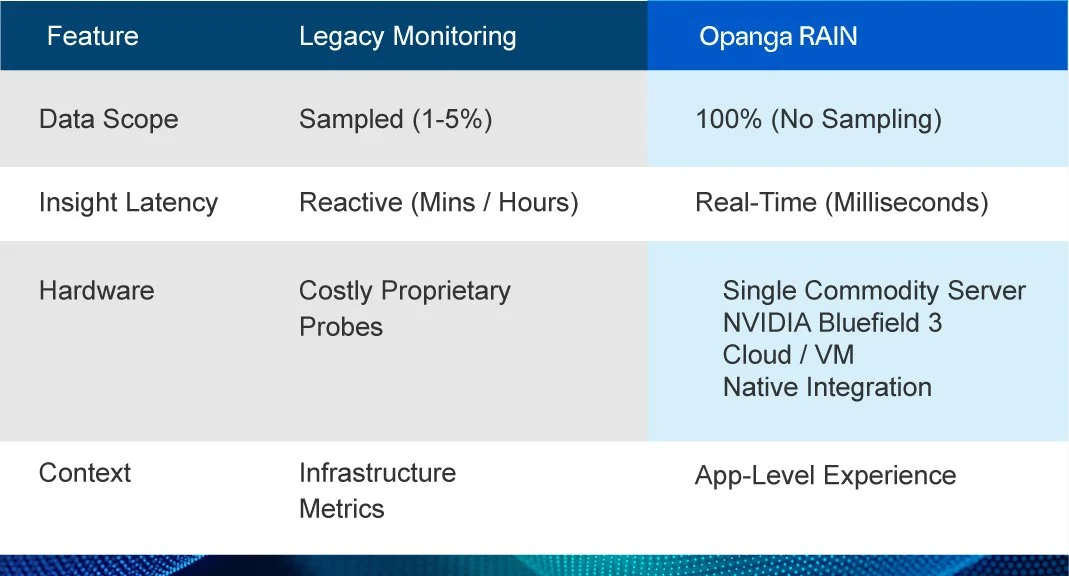
Operators are often drowning in data but starving for clarity. Historically, gaining 100% visibility required a massive investment in proprietary probes. Most operators still rely on:
Sampled Metrics: Missing the edge cases and "silent" failures that drive churn.
Delayed Processing: Introducing latency into insights that should be instantaneous.
Siloed Data: Monitoring only the control plane OR user plane information or storing them separately for different teams to analyze - preventing a full picture of behavior.
5. Use Cases for Today: Immediate ROI
The following use cases are implementable today on the RAIN platform, delivering measurable improvements to the P&L:
Precision Traffic Optimization: RAIN identifies high-throughput applications like HD video and large downloads in real time. Operators can manage these flows dynamically to prevent congestion, improving sector throughput by up to 40% without degrading service quality.
Dynamic Energy Savings: Instead of relying on static "sleep mode" timers, RAIN triggers power savings based on live customer demand. By powering down cells only when they are truly idle, operators achieve 20–40% energy savings per site.
Proactive Customer Care: Care agents no longer wait for a call. RAIN flags high-value users experiencing poor app-level performance, allowing teams to resolve issues or reach out proactively.
AIDrive Testing: Eliminate expensive, manual drive-test fleets. RAIN uses 100% of live traffic to generate a continuous, 24/7 "AI drive test" across every geography.
6. The AI Future: RAIN as the "Lifeblood" of the Autonomous Network
As operators transition to Agentic and Intent-Based Networking, the quality of data becomes the ultimate bottleneck. Historically, network operations and configuration management have been manual, labor-intensive, and slow because they were designed for human investigation and batch-processing.
We are now in an era where AI is the future, but we cannot assume the data collected for humans is suitable for machines. To calculate, train, and infer ML models for autonomous agents, AI requires data that is vastly more granular and time-sensitive. RAIN is the lifeblood of the AI-native operator.
The Reinforcement Learning Loop: RAIN does more than just trigger a change; it validates it. When an agent makes a network adjustment, RAIN immediately feeds the resulting customer experience back into the model. This creates a Reinforcement Learning loop where the AI learns—in real-time—whether its intervention had a positive or negative impact on the user, allowing for constant self-optimization.
Intent-Based Orchestration: RAIN provides the real-time feedback loop that confirms if the network is meeting a specific intent (e.g., latency for gaming), allowing the system to self-correct in milliseconds.
Agentic AI Enablement: For an AI agent to autonomously reroute traffic, it needs "eyes" that see everything. RAIN provides 100% traffic fidelity, ensuring AI doesn't act on "guess-timate" data.
Predictive Precision: RAIN feeds the AI "flywheel," moving from reactive troubleshooting to Predictive Precision—where the network anticipates and resolves experience-killing events before they occur.
7. What Makes RAIN Different
RAIN is not a tool; it’s a platform. It is a new layer of intelligence that complements existing infrastructure, systems, and priorities.
Built for real-time from day one: Not a repurposed solution, but designed natively for speed, precision, and integration.
100% traffic fidelity with no sampling: Nothing missed and no guessing.
Application-level scoring: Insights reflect actual user experience, not abstract performance proxies.
AI-native output: Data is cleaned, enriched, and labeled for immediate use by downstream ML and AI systems.
Lightweight deployment: No probes, no racks of gear, and no proprietary hardware. One server—plug and go.
8. Proof Points & Real-World Results
FWA Revenue Increase: Unlocking 30% Growth
A Tier-1 North American operator used RAIN to solve capacity exhaustion. Operators typically "embargo" (stop selling) Fixed Wireless Access (FWA) services when RAN KPIs indicate capacity is exhausted, as one FWA user consumes 50X the bandwidth of a mobile user.
The Challenge: Bandwidth-intensive HD Video was wreaking havoc on network performance, leading to 593 embargoed sectors - capping FWA revenue.
The Result: RAIN improved user speeds by 24% and spectral efficiency.
The Revenue Impact: The operator removed sales embargoes on 134 sectors, increasing the total FWA revenue opportunity by 30% without new infrastructure.
Software vs. Hardware: 28X ROI
Traditional options for expanding capacity—adding frequency layers or building new sites—carry high costs and long deployment times. RAIN offers a software virtual capacity layer that is an order of magnitude cheaper and deployed overnight.
The Deployment: 10K sites handling 320Gbps of traffic.
The RAIN Effect: 18% fewer sites needed hardware upgrades, while busy-hour throughputs improved by 20%+.
The Business Case: The operator realized a 28X ROI compared to traditional hardware paths, saving approximately $134M USD annually.
Sustainability: Precision Energy Savings
RAIN’s Smart Energization aligns power consumption with actual user behavior.
Impact: Early deployments have achieved 20–40% energy savings per site.
Accuracy: Because RAIN monitors 100% of activity, it triggers power-down sequences with confidence that no active user will be impacted.
9. Conclusion: Visibility is Power
You cannot manage what you cannot measure. With Opanga RAIN, mobile operators gain the one signal that has been missing: live, full-network, customer-centric intelligence. It powers the operations of today and provides the data foundation for the AI of tomorrow.
Welcome to the CX era.
